

November 2026 — News release
OPPAIR is putting a direct answer behind the fastest-rising line item in modern sheet metal shops: the cost of cutting gas. The company's skid-mounted laser special screw air compressor series delivers high-pressure, bone-dry compressed air at 16 to 20 bar straight to the cutting head, and fabricators replacing bottled or bulk liquid nitrogen with the package are reporting cuts of 60% to 80% in auxiliary gas spending.
The shift is being pushed by the cutting machines themselves. As 12 kW, 20 kW and 30 kW fiber lasers become routine equipment, cutting speeds and thickness capacity have climbed — and so has gas consumption. In high-volume operations, monthly nitrogen and oxygen invoices can account for 30% to 40% of total workshop running costs.
Why split air systems fail at the cutting head
Many fabricators first try a general-purpose compressor connected to the laser by external piping. In laser cutting duty, that layout exposes three predictable failure modes:
- Secondary condensation in long pipe runs. Split installations need extensive external piping between compressor, receiver and dryer. In humid or temperature-fluctuating workshops, moisture re-forms downstream of the dryer.
- Oil and water at the optics. Even microscopic droplets, or residual lubricating oil at 0.1 ppm and above, reaching the nozzle can destroy protective windows, collimating lenses and focusing mirrors — with replacement costs and unplanned downtime to match.
- Pressure drop at piercing. High-power piercing and corner work demand immediate, sustained bursts of high-pressure air. Undersized or split buffer volume causes instant pressure loss, incomplete cuts, dross and burred edges.
What is integrated on the skid
OPPAIR's answer is to mount every gas-treatment stage on a single structural steel skid, factory-piped, pre-wired and tested before shipment, so commissioning is limited to the electrical and air connections.
1. Permanent magnet variable speed drive
IE4/IE5 permanent magnet synchronous motors modulate speed to instantaneous air demand. Whether the laser is idling during sheet loading or running at maximum cutting speed, unloaded idling losses disappear, with up to 30% lower electrical power consumption than fixed-speed units.
2. Two-stage drying: refrigerated plus adsorption
A plate-exchange refrigerated dryer is paired with a modular twin-tower adsorption desiccant dryer. The combination holds a constant pressure dew point of -20°C to -40°C, against the +3°C to +10°C reachable by a standard refrigerated dryer alone, so there is no pipeline condensation regardless of ambient climate.
3. Five-stage filtration to 0.001 µm
CTAFH/CTAXF high-efficiency elements run the air through mechanical separation, particulate trapping, micro-coalescing and activated carbon oil-vapour adsorption in sequence:
- Solid particle retention: down to 0.001 µm
- Residual oil content: below 0.003 ppm (0.003 mg/m³)
4. Dual 600 L receivers: 1200 L of high-pressure buffer
Two certified 600 L high-pressure tanks keep discharge pressure steady at 16 bar or 20 bar through high-speed piercing, rapid direction changes and continuous multi-shift cutting.
Matching the skid to the laser
Laser power and workpiece thickness set the required pressure and flow. OPPAIR publishes a matching table for its integrated 4-in-1 and 5-in-1 series and the skid-mounted range:
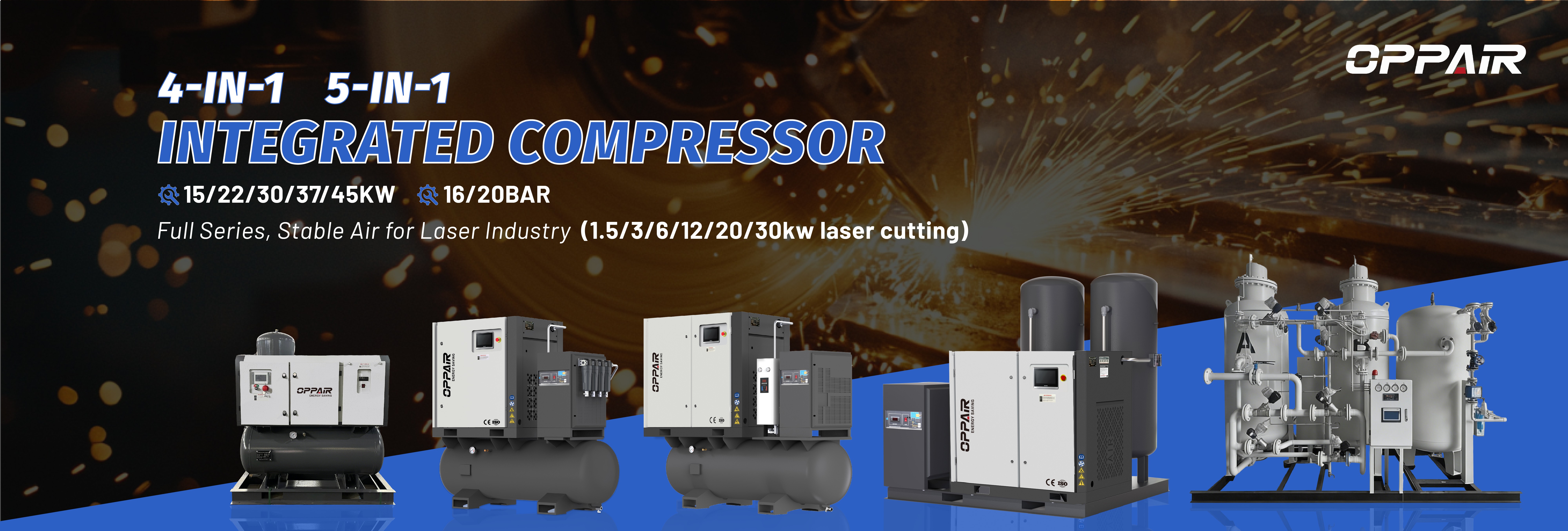
| Laser power | Recommended unit | Motor power | Working pressure | Free air delivery |
|---|---|---|---|---|
| 1.5 kW – 3.0 kW | Integrated 4-in-1 / Skid 16 | 11 kW / 15 kW | 16 bar | 1.0 – 1.4 m³/min |
| 6.0 kW – 12 kW | Laser-30PV/16 | 22 kW (30 HP) | 16 bar | 2.0 m³/min |
| 12 kW – 20 kW | Laser-40PV/16 | 30 kW (40 HP) | 16 bar | 3.4 m³/min |
| 20 kW – 30 kW (heavy gauge) | Laser-40PV/20 | 30 kW (40 HP) | 20 bar | 2.72 m³/min |
| 30 kW – 60 kW (ultra-high power) | Laser-50PV/20 | 37 kW (50 HP) | 20 bar | 3.4 m³/min |
Note: for stainless and carbon steel above 16 mm, 20 bar delivers noticeably higher kinetic blowing energy, which keeps the cut face clean and dross-free.
Payback in three to six months
On a standard eight-hour shift, liquid nitrogen supply typically runs $1,200 to $2,500 per month depending on sheet volume. Running a Laser-30PV/16 instead costs roughly $300 to $450 per month in electricity. Most fabrication shops report full equipment payback within three to six months, after which the ongoing saving works directly on workshop margin.
About OPPAIR
Shandong OPPAIR Machinery Manufacturing Co., Ltd. and OPPAIR Compressor (Shanghai) Co., Ltd. build screw air compressors for high-demand industrial sectors. Equipment ships to more than 100 countries across Europe, the Americas, the Middle East and Southeast Asia, and is certified to CE, SGS, ASME, TUV and ISO 9001. Standard export delivery is 30 days, with up to three years of factory warranty on IP65 PM VSD core assemblies.
Explore the range
- Skid mounted laser air compressor — integrated high-pressure packages for fiber laser cutting
- 4-in-1 laser cutting compressor and 5-in-1 laser cutting compressor — all-in-one units from 11 kW to 45 kW
- Two-stage high-pressure screw air compressor — 20 to 30 bar duties
- Oil-cooled screw air compressor — heavy-duty continuous operation
- Oil-free air compressor — Class 0 oil-free air where the process demands it
- Modular adsorption air dryer and nitrogen generator — drying and on-site gas supply
To size a skid against a specific laser, send the laser power, material thickness and shift pattern through the contact page and OPPAIR will propose a configuration. OPPAIR is also recruiting agents and distributors worldwide.